Affiliate disclosure: This article contains an Amazon affiliate link. If you make a qualifying purchase, BlockTechBuzz may earn a commission at no additional cost to you. As an Amazon Associate I earn from qualifying purchases.
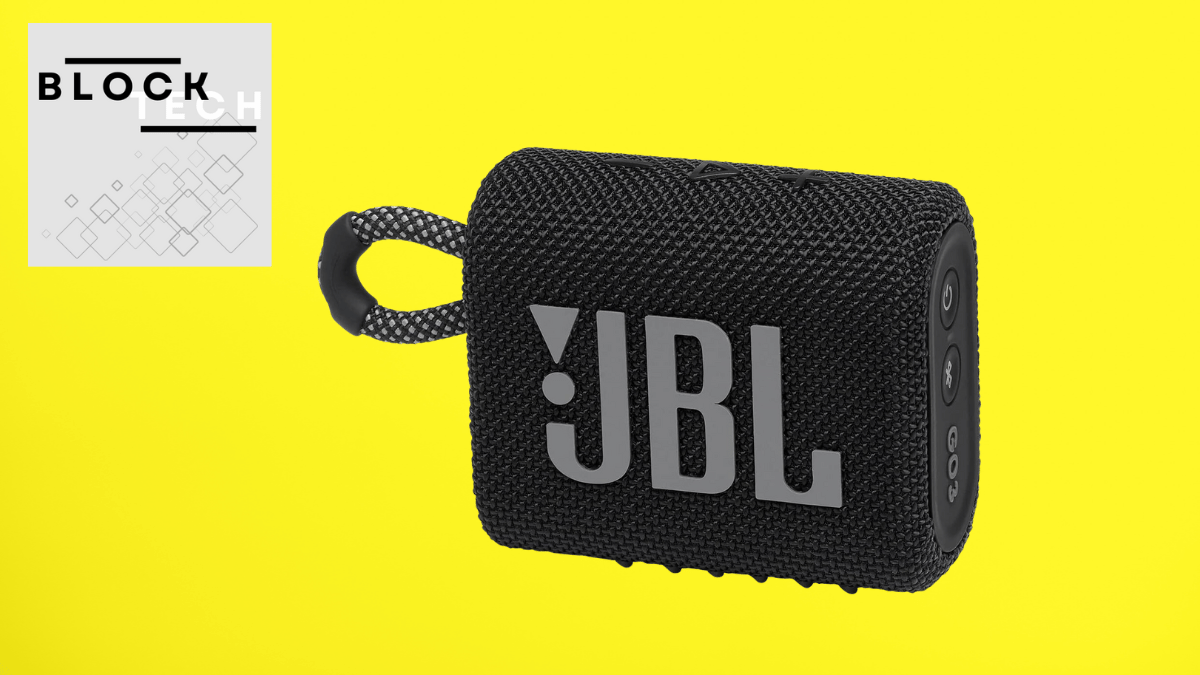
This JBL GO 3 review looks at what the pocket-size Bluetooth speaker actually offers, where its limits matter and who should consider it. The assessment is based on JBL’s published specifications and operating documentation, not invented listening tests or customer testimonials.
The GO 3 combines a 4.2-watt mono driver, Bluetooth 5.1, USB-C charging and an IP67 dust-and-water rating in a 209-gram body. JBL rates playback at up to five hours, with the important qualification that volume and audio content affect the result. It is designed for convenient personal listening, not for stereo separation, deep sub-bass or an all-day party.
Check the seller, color, condition, warranty and return terms. JBL has released newer compact speakers, so confirm that the listing is specifically for the GO 3.
JBL GO 3 review: quick assessment
The GO 3 is a sensible choice when size, simplicity and weather resistance matter more than maximum volume or battery endurance. It fits easily in a small bag, pairs without an app and can tolerate the sort of water and dust exposure covered by its IP67 rating. The integrated loop is useful for carrying, although JBL does not describe it as climbing or safety hardware.
Its biggest constraints are built into the format: one small driver, no stereo-pair mode in JBL’s published feature set, no microphone for calls, no analog audio input and a maximum rated five-hour battery. Listeners who want room-filling output, strong low bass or long playback should choose a larger speaker.
| Specification | JBL GO 3 |
|---|---|
| Output | 4.2W RMS |
| Transducer | 43 × 47mm |
| Frequency response | 110Hz–20kHz |
| Bluetooth | Version 5.1; A2DP 1.3 and AVRCP 1.6 |
| Protection | IP67 dustproof and waterproof |
| Battery | 2.775Wh lithium-ion polymer |
| Rated playback | Up to 5 hours, depending on volume and content |
| Charge time | 2.5 hours at 5V/1A |
| Weight | 0.209kg / 0.46lb |

Design and portability
The GO 3 measures roughly 3.4 by 2.7 by 1.6 inches. Its fabric-covered shell, rubberized sections and oversized logo give it a more rugged appearance than a bare plastic speaker. At 0.46 pounds, it is light enough for a backpack, kitchen counter or hotel room without demanding much space.
The side loop is permanently attached and convenient for retrieving the speaker from a bag. Treat it as a carrying loop rather than an assurance against falls. The product literature publishes an ingress-protection rating, but not a formal drop-resistance rating. The old article said it could survive drops; that claim is not supported by JBL’s specifications.
Physical controls handle power, Bluetooth pairing, volume and playback. The simple layout is valuable for people who do not want an account or companion app. The trade-off is that JBL does not provide app-based equalization for this model.
Sound quality and realistic expectations
JBL calls the sound “JBL Pro Sound” and markets the bass as punchy. Those are manufacturer descriptions, not measurements of subjective quality. The objective figures are a 4.2W RMS amplifier rating, one 43 × 47mm transducer and a stated response of 110Hz to 20kHz.
A lower limit of 110Hz means the GO 3 cannot reproduce the deepest bass fundamentals that larger speakers and subwoofers handle. It can emphasize upper-bass rhythm, but listeners should not expect true low-frequency extension. Its single driver also creates mono output. Positioning can still make a noticeable difference: place the speaker on a stable surface, with its front unobstructed, rather than burying it in a bag or corner.
Spoken podcasts, background music and casual listening suit the format well. At high volume, any ultra-compact speaker has less headroom than a larger enclosure. For a broader comparison, see our guide to portable Bluetooth speaker options. Product generations and prices change, so compare current specifications rather than relying on an old ranking.
What IP67 does—and does not—mean
The first digit in IP67 indicates the highest dust-ingress classification in the IP code. The second indicates protection against temporary immersion under the test conditions defined for the rating. JBL’s quick-start material illustrates one meter for up to 30 minutes.
That does not make the speaker suitable for swimming, high-pressure jets, saltwater exposure or underwater operation. Water resistance can also diminish with damage and age. Keep the USB-C port dry before charging, rinse off accidental fresh-water contamination as directed by the manufacturer, and avoid soap, pool chemicals and sand packed into openings.
The old article said users could “dunk it without a second thought” and keep using it after it fell into a pool. That is too broad. IP testing is a controlled limit, not a recommendation to immerse electronics deliberately.
Bluetooth 5.1 and device compatibility
The GO 3 uses Bluetooth 5.1 and publishes A2DP 1.3 for audio streaming plus AVRCP 1.6 for playback control. It can pair with phones, tablets and computers that support compatible Bluetooth audio. The version number alone does not guarantee a particular range; walls, interference, source hardware and radio congestion all affect stability.
- Turn on the speaker and press the Bluetooth button to enter pairing mode.
- Open Bluetooth settings on the phone, tablet or computer.
- Select JBL GO 3 and wait for confirmation.
- Start at a moderate volume, then adjust the source and speaker controls.
If pairing fails, forget the speaker in the source device, restart both products and try again away from other active Bluetooth devices. There is no published 3.5mm analog input, so a device without Bluetooth needs a separate Bluetooth transmitter.
Battery life and charging
JBL rates the GO 3 for up to five hours of music playback and explicitly notes that volume level and audio content affect the result. Higher volume generally consumes energy faster. Battery capacity also declines with charge cycles, time and exposure to heat, so an older unit may not match the original rating.
The specified charge time is 2.5 hours using a 5V/1A supply. A USB-C cable is included, but JBL’s box list does not specify a wall charger. Use a compliant power source and avoid charging when the port is wet. The USB-C connection is for charging; the documentation does not present it as a wired digital-audio input.
For battery longevity, avoid leaving the speaker in a hot car, recharge it periodically during long storage and do not use a visibly damaged cable. A five-hour maximum is sufficient for shorter outings but restrictive for a full workday or weekend without power.
Best uses for the JBL GO 3
Travel and personal listening
The size and weight make the GO 3 convenient for hotel rooms, picnics and low-volume listening near the user. Be considerate in shared outdoor spaces; a portable speaker does not override local noise rules or other visitors’ preferences.
Kitchen, workshop and bathroom
IP67 protection makes splashes and dust less worrying than with an unrated speaker. Keep it away from heat, machinery and direct high-pressure water, and never charge it in a wet location.
Projector or laptop audio
The GO 3 can play audio from a Bluetooth-capable laptop or source device. It may complement a compact display setup, including the ELEPHAS mini projector, but Bluetooth latency can cause lip-sync delay. A wired speaker connected directly to the projector is often more predictable for video.
Limitations to know before buying
- Short battery ceiling: up to five hours is modest by current portable-speaker standards.
- Mono output: one speaker cannot create conventional left-right stereo separation.
- Limited deep bass: the published response begins at 110Hz.
- No analog input: Bluetooth is the audio path described in JBL’s documentation.
- No speakerphone claim: JBL’s specifications do not list a microphone.
- No app EQ: the GO 3 is a simple standalone speaker rather than an app-managed model.
If private listening, active noise cancellation or spatial-audio features matter more than shared playback, headphones such as those discussed in our AirPods Max review serve a different purpose. A small Bluetooth speaker is primarily about convenience and shared sound.
What to compare with a newer compact speaker
The GO 3 can still be useful, but it should be compared with current models on more than sale price. Battery runtime, charging speed, repairability, multi-speaker support and codec behavior can differ substantially. A newer product is not automatically better, and a discounted GO 3 is not automatically good value if its battery has been stored for years.
- Size and weight: decide whether pocketability is more important than bass and output.
- Runtime: compare manufacturer estimates under similar conditions and remember that maximum figures are not guarantees.
- Ingress rating: compare both digits; “water-resistant” alone says little about dust protection.
- Pairing features: check whether stereo or party linking requires the same product generation or app.
- Inputs: determine whether Bluetooth-only playback is acceptable or an analog connection is needed.
- Support: verify the regional warranty and whether the seller is authorized.
For the GO 3 specifically, its clear strengths are low weight, a documented IP67 rating and uncomplicated operation. Its published five-hour ceiling is the specification most likely to push frequent travelers toward a larger or newer alternative. Buyers who listen mainly at a desk or during short outings may reasonably prefer the smaller enclosure.
How to evaluate a used or discounted GO 3
- Confirm the exact model and inspect the USB-C port for corrosion or damage.
- Test pairing, buttons and charging.
- Play speech and bass-heavy music at several volume levels and listen for rattling.
- Do not assume the original IP67 performance after unknown damage or repair.
- Ask about battery runtime; replacement may not be economical on a low-cost sealed speaker.
Frequently asked questions
Can the JBL GO 3 be submerged?
Its IP67 rating covers controlled temporary immersion, illustrated by JBL as up to one meter for 30 minutes. It should not be intentionally used underwater, exposed to high-pressure water or charged while wet.
Can two GO 3 speakers play in stereo?
JBL’s GO 3 documentation does not list stereo pairing, PartyBoost or an equivalent multi-speaker feature. Treat each GO 3 as a standalone mono speaker.
Does it have a microphone?
No microphone or speakerphone function appears in JBL’s published specification. Calls remain on the connected phone unless another audio route is selected.
How long does the battery last?
JBL says up to five hours, depending on volume and the content being played. Real runtime also depends on battery age, temperature and usage.
Verdict
The JBL GO 3 remains a practical small speaker for buyers who prioritize portability, simple Bluetooth playback and a documented IP67 rating. Its official specifications support those strengths. They do not support claims of drop-proof construction, stereo sound, deep bass or all-day battery life. Buy it for convenient personal and small-space listening; choose a larger model when output, bass extension or endurance matters more than pocketable size.
Leave a Reply