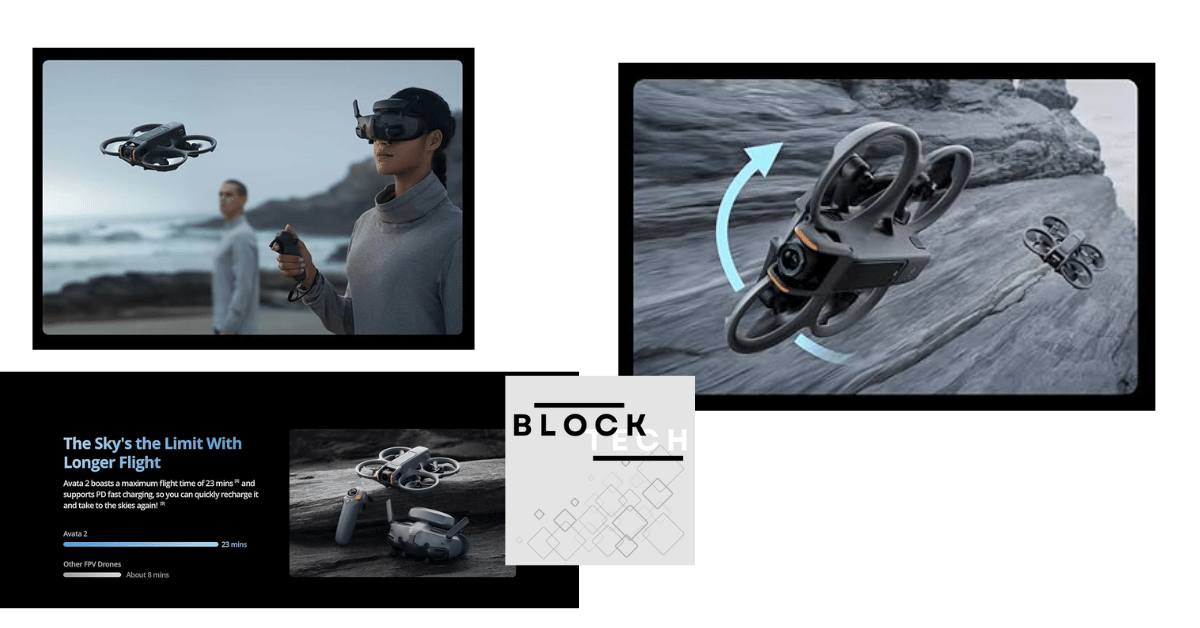
This DJI Avata 2 review focuses on verified specifications, practical flight tradeoffs, and the rules that first-person-view pilots need to understand. Avata 2 is a compact FPV drone with integrated propeller guards, a goggles-based view, electronic image stabilization, and optional motion or conventional FPV controls. It is designed for immersive, close-range flying rather than the long, steady aerial photography workflow of a conventional camera drone.

DJI Avata 2 review: key specifications
| Takeoff weight | Approximately 377 g |
|---|---|
| Camera | 1/1.3-inch sensor, 12 effective megapixels, 155° field of view |
| Video | Up to 4K/100 fps in 16:9; 4K/60 fps in 4:3; H.264/H.265 |
| Stabilization | Single-axis mechanical tilt gimbal plus RockSteady 3.0+ or HorizonSteady electronic stabilization |
| Claimed maximum flight time | Approximately 23 minutes under DJI’s controlled test conditions |
| Internal storage | 46 GB |
| Positioning sensors | Downward and backward vision plus downward time-of-flight sensing |
| Maximum horizontal speed | 8 m/s Normal, 16 m/s Sport, and 27 m/s Manual under DJI’s stated conditions; regional limits apply |
These are manufacturer specifications, not guaranteed real-world results. Wind, temperature, battery condition, flight style, video settings, interference, firmware, and local restrictions can all change performance. DJI measures its maximum 23-minute flight time in a controlled, windless test with a constant forward speed. Aggressive FPV flying normally uses energy faster.
What makes Avata 2 different from a camera drone?
A conventional camera drone is usually optimized to hover, frame a shot, and move smoothly while the pilot watches a controller screen. Avata 2 sends the live view to compatible goggles and is shaped to move through tighter spaces with a wide perspective. The integrated propeller guards reduce the chance that a light contact immediately strikes an exposed propeller, but they do not make the aircraft collision-proof or safe to fly near people.
The standard motion-control experience is accessible because hand movement directs the aircraft and assisted modes limit some complexity. Manual mode with the DJI FPV Remote Controller 3 is different: it removes much of the automatic leveling that beginners rely on and demands training. A simulator and large, clear practice area are sensible before attempting acrobatic flight.
For buyers deciding between immersive FPV and a lighter travel camera, the site’s DJI Mini 4K guide explains the other approach. The two products are not simple substitutes: one prioritizes cockpit-like flying and dynamic angles, while the other emphasizes portability, longer claimed endurance, and conventional stabilized aerial capture.
Design, durability, and repair considerations
At about 377 g, Avata 2 is compact but sits above the 250 g threshold that matters in several regulatory systems, including U.S. recreational registration rules. Its duct-like guards surround the propellers and make the aircraft less vulnerable to minor side contact than an open-prop design. The low profile and wide camera suit proximity flying, and 46 GB of internal storage can rescue a session when a memory card is forgotten.
Protection has limits. A guarded propeller can still injure, damage property, or break after a hard impact. Fine branches, wires, reflective surfaces, low light, water, and textureless surfaces can defeat visual sensing. DJI lists only downward and backward visual positioning, so the old article’s claim of sensors on all sides was incorrect. Forward flight still requires active judgment.
Potential owners should price batteries, replacement propellers, storage media, compatible goggles, a controller, and any service plan as part of the system. Package contents vary, and compatibility matters: an accessory that works with an earlier DJI FPV product is not automatically supported by Avata 2.
Camera quality and stabilization
The 1/1.3-inch sensor records 12-megapixel stills and offers a very wide 155-degree field of view. DJI supports 4K recording at up to 100 frames per second in 16:9 and up to 60 fps in the taller 4:3 format. Ten-bit D-Log M is available for users who plan to color grade, while the standard profile is easier for quick delivery.
The original article incorrectly described a 48-megapixel camera and three-axis gimbal. Avata 2 uses a single-axis mechanical tilt gimbal combined with electronic stabilization. RockSteady 3.0+ aims to reduce vibration and rotational shake, while HorizonSteady can keep the horizon level within its operating limits. Stabilization is effective for FPV footage, but it is not identical to the optical freedom of a three-axis camera-drone gimbal.
The wide lens creates energetic motion and makes close passes feel fast. It can also distort subjects near the edge of the frame. Low-light quality remains constrained by a small airborne camera and the need for short exposures during movement. The best results come from adequate light, deliberate routes, clean lenses, and settings chosen before takeoff.
Flight controls and learning curve
DJI RC Motion 3 lowers the entry barrier by translating wrist movements and trigger input into flight commands. Easy ACRO can automate moves such as flips, rolls, and drifts when conditions permit. Those features make dramatic motion accessible, but an automated maneuver is not a substitute for checking clearance, people, airspace, and recovery space.
The optional FPV Remote Controller 3 supports a more conventional two-stick layout and Manual mode. In Manual, the aircraft can fly up to DJI’s stated 27 m/s maximum under applicable conditions, but DJI notes a lower limit in EU regions. Manual flight is substantially harder because the pilot must control attitude and throttle continuously. New users should master Normal and Sport modes first.
- Normal mode: the most assisted option for learning orientation and basic routes.
- Sport mode: faster response while retaining automatic leveling behavior.
- Manual mode: intended for trained pilots using the compatible FPV controller; mistakes develop quickly.
Battery life, transmission, and real-world range
DJI advertises about 23 minutes of maximum flight time and up to 13 km of transmission distance under specified FCC test conditions. Neither number should be treated as permission to fly to the limit. A safe plan preserves energy for return, landing, wind, route changes, and unexpected delays. Fast, repeated acceleration reduces endurance, while cold weather can affect battery performance.
Transmission range is a laboratory-style capability affected by region, interference, obstacles, and local law. In the United States, recreational pilots must keep the drone within visual line of sight or use a co-located visual observer who can see it unaided and communicate directly with the pilot. A goggles display alone does not satisfy that responsibility. The site’s broader guide to drone applications and regulations provides additional context, but pilots must check current rules where they fly.
Safety and U.S. regulatory basics
Rules vary by country and can change. In the United States, Avata 2’s weight means recreational pilots generally must register it, display the registration number, complete the free TRUST safety test, and carry proof. If the aircraft requires registration, Remote ID requirements generally apply unless an exception such as operation within a recognized identification area is available. Controlled airspace may require prior authorization, and recreational flight in Class G airspace is generally limited to 400 feet above ground level.
- Keep the aircraft within visual line of sight or use a properly positioned visual observer.
- Give way to crewed aircraft and never fly carelessly or recklessly.
- Check airspace, temporary restrictions, local rules, and landowner requirements before takeoff.
- Do not assume propeller guards permit flight over people.
- Use a clear launch and recovery area, especially when wearing goggles.
As an Amazon Associate, BlockTechBuzz earns from qualifying purchases. This does not affect the price you pay.
DJI Avata 2 versus DJI Mini 4K
| Decision factor | DJI Avata 2 | DJI Mini 4K |
|---|---|---|
| Primary purpose | Immersive FPV and dynamic proximity footage | Portable conventional aerial photography |
| Takeoff weight | Approx. 377 g | Under 249 g |
| Claimed maximum flight time | Approx. 23 minutes | Approx. 31 minutes |
| Camera support | Wide 4K FPV capture, up to 4K/100 fps in 16:9 | 4K capture up to 30 fps |
| Mechanical gimbal | Single-axis tilt | Three-axis |
| Viewing/control concept | Goggles with motion controller or FPV controller | Conventional remote and screen |
| Best fit | Pilots prioritizing an immersive experience and unusual motion | Travelers prioritizing weight, endurance, and stable framing |
Choose based on the footage and flight experience you want, not on a single specification. Avata 2’s wider, faster perspective is the point; Mini 4K is the more straightforward option for calm establishing shots and travel. Creators who want a camera for ground and action use rather than an aircraft can also compare the DJI Osmo Action 3 Outdoor Combo.
Strengths and limitations
A practical preflight workflow
A repeatable preflight routine matters more than a dramatic specification. Charge the aircraft, goggles, and controller; inspect propellers and guards; confirm that firmware and compatible components recognize one another; check storage space; clean the camera and sensors; and verify the home point after satellite positioning is available. Set the return-to-home altitude with nearby obstacles in mind rather than accepting a number without reviewing the location.
Walk the intended route before flying close to objects. Look for thin branches, cables, reflective surfaces, animals, people, moving vehicles, and areas where the aircraft could be difficult to retrieve. Agree on simple callouts with the visual observer. Begin with a short hover and control check, then land with a reserve rather than continuing until the battery forces the decision. After flight, let batteries cool before charging and review the aircraft for impact damage.
Strengths
- Immersive goggles-based flight
- Integrated propeller guards
- Wide 4K capture with high-frame-rate options
- Useful electronic stabilization
- Substantial internal storage
Limitations
- Shorter endurance than many camera drones
- No omnidirectional obstacle avoidance
- Single-axis mechanical gimbal
- Full system cost includes goggles, controller, and batteries
- FPV rules and visual-observer requirements add planning
Frequently asked questions
Is DJI Avata 2 suitable for beginners?
Normal mode, motion control, tutorials, and assisted features make basic flight approachable. That does not make close-proximity or Manual-mode flight beginner-safe. Start in a large clear area and build skills gradually.
Does Avata 2 have a three-axis gimbal?
No. DJI specifies a single-axis mechanical tilt gimbal, supported by electronic stabilization and roll correction.
Does Avata 2 avoid obstacles in every direction?
No. DJI lists downward and backward visual positioning, plus downward time-of-flight sensing. The pilot remains responsible for the flight path.
Can you fly Avata 2 using only the goggles view?
The aircraft is designed around a goggles view, but local rules still apply. In the United States, FPV operation requires visual-line-of-sight compliance, commonly through a co-located visual observer in direct communication with the pilot.
Final assessment
DJI Avata 2 is a specialized FPV system, not a universal replacement for a camera drone. Its strengths are the immersive view, protected compact design, wide stabilized footage, and relatively accessible assisted controls. Its limits are equally important: modest real-world endurance, incomplete obstacle sensing, a one-axis mechanical gimbal, system cost, and the discipline required to fly FPV legally and safely.
It makes the most sense for a buyer who specifically wants dynamic FPV flight and is prepared to practice, use a visual observer where required, and plan each route. A traveler who mainly wants steady landscapes may get more value from a sub-250 g camera drone. Official measurements and compatibility details should always be checked on the current DJI Avata 2 support page before purchasing accessories or relying on a specification.
Leave a Reply