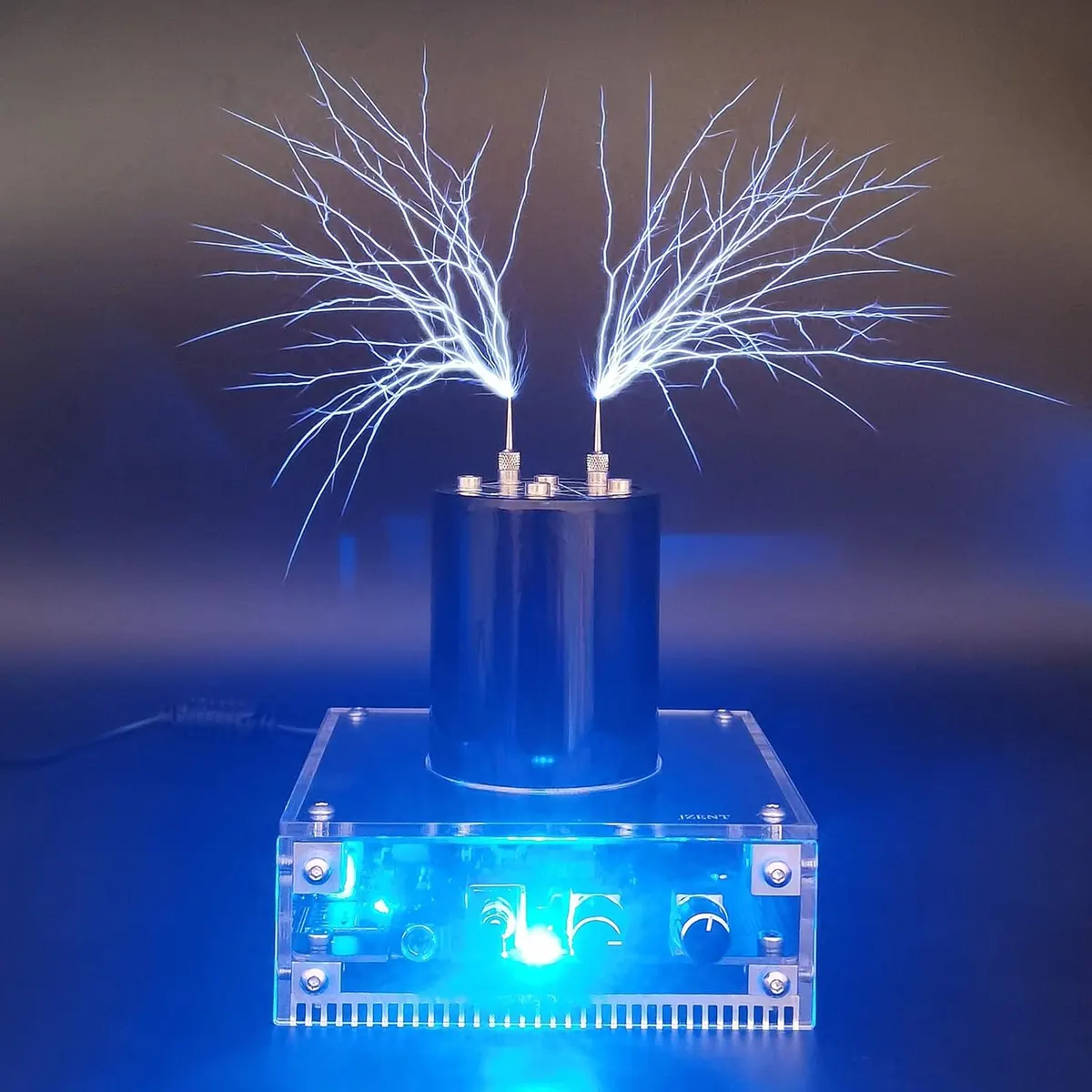
The JZENT Tesla coil sold as a “Bluetooth Music Tesla Coil SSTC” is a small solid-state Tesla coil that modulates visible electrical discharges in response to audio. It is a striking demonstration device, but the phrase “plasma speaker” can create the wrong expectation: this is not a conventional Bluetooth speaker, and exposed high-voltage arcs demand more care than an ordinary desktop gadget.
This guide evaluates the product from documented listings and established electrical-safety principles; it is not a claim of hands-on testing. JZENT-branded listings identify the unit as model JE-28 and describe Bluetooth audio input, an external power supply, and a compact enclosure. Specifications vary across sellers, so buyers should confirm the exact model, power supply, controls, and included accessories before ordering.

As an Amazon Associate, Block Tech Buzz earns from qualifying purchases.
What a musical solid-state Tesla coil does
A Tesla coil is a resonant transformer that produces high-frequency, high-voltage output. Traditional designs use a spark gap; a solid-state Tesla coil (SSTC) replaces that switching mechanism with semiconductor electronics. The JZENT device uses its high-voltage output to create a short corona or arc at the top electrode.
In music mode, the control electronics vary the discharge according to an audio signal. The rapidly changing arc moves the surrounding air, making the waveform audible. There is no paper cone or conventional speaker driver. Expect a bright, buzzy electrical rendering whose quality depends on the source level, room noise, and operating distance—not the full-range sound of the products in our Bluetooth speaker buying guide.
JZENT Tesla coil features and claims
Retail listings for the JE-28 describe the following. These are seller or manufacturer-supplied claims, not measurements independently verified by Block Tech Buzz.
| Item | What listings state | What to verify |
|---|---|---|
| Audio input | Bluetooth music modulation | Pairing procedure, supported input, and whether volume must be controlled at the source |
| Power | An external 48 V, 2 A adapter is commonly listed | Input voltage, plug type, certification marks, and adapter included with the specific offer |
| Arc | A short visible discharge whose length varies with setup | No arc length should be treated as guaranteed; environment and settings matter |
| Protection | Some listings mention temperature protection | Do not assume this makes unattended or extended operation safe |
| Purpose | Desktop demonstration, wireless-lighting demo, and music visualization | It is not a child-safe toy or a normal room speaker |
The compact format is the main appeal. It can demonstrate resonant high voltage, corona discharge, and audio modulation without the size of a performance coil. The same compactness can also encourage casual handling. The exposed discharge should be treated as energized, and the device belongs in a controlled demonstration area rather than among everyday desk clutter.
Marketplace titles can bundle several descriptive terms—SSTC, arc generator, plasma loudspeaker, wireless-transmission model, and desktop toy—into one listing. Those phrases describe possible demonstrations, not separate certified functions. Product photos may also be reused between sellers. Compare the control layout, enclosure, electrode, adapter label, and printed model number across every image. If the delivered hardware differs, pause before powering it and ask the seller to confirm the manual and electrical ratings for that exact revision.
Safety comes before the spectacle
A small arc is still an electrical and thermal hazard. OSHA notes that electrical arcs can burn skin and ignite flammable material even at comparatively low supply voltages. The Tesla coil’s external adapter voltage also does not describe the much higher voltage produced at the output electrode.
Do not touch the arc or electrode
Keep hands, jewelry, tools, wires, and conductive objects away while the unit is powered. High-frequency current behaves differently from household mains, but that does not make contact safe. Burns, unexpected current paths, secondary arcs, and damage to the electronics remain possible. Turn the unit off and disconnect its adapter before moving, cleaning, or inspecting it.
Keep it away from medical implants
Do not operate the device near anyone with a pacemaker, implanted defibrillator, neurostimulator, insulin pump, or other electronic medical device unless the device manufacturer and clinician have confirmed an appropriate separation and procedure. Tesla coils create strong electromagnetic fields. The FDA explains that medical devices can be susceptible when electromagnetic energy exceeds the immunity for which they were designed and tested. A generic distance guessed from another product is not an adequate safety rule.
Protect nearby electronics
Operate well away from phones, computers, storage devices, payment cards, smartwatches, radios, and sensitive test equipment. Electromagnetic and radio-frequency energy can disrupt or damage electronics, and the discharge can couple into nearby conductors. Remove unnecessary cables and do not place the coil on a metal table.
Use a dry, clear, ventilated area
Keep the coil away from water, aerosols, solvents, paper, fabric, fuel, and other flammable material. The arc can generate ozone and nitrogen oxides. The U.S. Environmental Protection Agency notes that ozone can irritate the lungs and worsen respiratory conditions, with exposure affected by concentration, duration, room size, and ventilation. Stop operation if anyone experiences irritation, coughing, chest discomfort, or breathing difficulty, and move to fresh air. A sharp electrical odor is not a feature to intensify.
Supervise every demonstration
This product should not be treated as a children’s toy, even when a listing describes it as educational. A knowledgeable adult should control the power, boundaries, and run time. Never leave it energized unattended, and do not let spectators reach over the device. Schools and public venues should use their own electrical-safety review rather than relying on marketplace copy.
A careful setup sequence
- Inspect before connecting power. Look for a cracked enclosure, bent electrode, loose parts, damaged cable, scorched components, or an adapter that does not match the listing.
- Choose the location. Use a stable, dry, nonconductive, heat-resistant surface with open space around and above the discharge.
- Clear the area. Remove flammables, metal objects, loose cables, and sensitive electronics. Confirm that no person with an electronic implant is nearby.
- Set source volume low. Pair the audio source using the seller’s instructions, then begin at a low output level to avoid abrupt modulation.
- Apply power without touching the unit. Stand back and observe. If the device behaves erratically, emits smoke, overheats, or produces a damaged-electronics smell, disconnect power at a safe point.
- Use short sessions. Follow the supplied manual’s duty cycle and cooling guidance. If no reliable manual is included, do not infer that continuous operation is safe.
- Power down fully. Switch off and unplug before changing position. Allow the unit to cool before storage.
If the unit connects to a phone, apply the same sensible device hygiene covered in our home cybersecurity guide: use normal Bluetooth pairing controls, remove the pairing when it is no longer needed, and do not install an unknown app simply because a marketplace insert requests it.
What the JZENT coil is good for
- Short, supervised demonstrations: It can make resonance, high voltage, corona, and audio modulation visible and audible.
- Conversation-piece displays: The discharge has more visual impact than a conventional desktop speaker, provided the operating area is controlled.
- Comparing sound visualization methods: It offers an interesting contrast with a sealed music-reactive ferrofluid display, though the two products use completely different physics and have different hazards.
It is a poor fit when the goal is high-fidelity music, background audio, unattended decoration, a bedside device, or a hands-on toy. Anyone who cannot provide clearance from medical devices, electronics, flammables, and unsupervised visitors should choose a different display.
What to check before buying
- Exact model: Confirm JE-28 or the model actually pictured, not just a reused title.
- Power compatibility: Check mains input, output rating, plug type, polarity, and included adapter. Do not substitute an adapter based only on connector fit.
- Documentation: Look for intelligible operating, duty-cycle, shutdown, and safety instructions.
- Seller identity and returns: Verify who handles a damaged unit, missing adapter, or product that differs from the listing.
- Compliance markings: Ask for documentation relevant to electrical safety and radio equipment in your country; a logo in a photo is not the same as a verifiable certificate.
- Replacement parts: Do not assume electrodes, power supplies, or control boards are standardized.
- Environment: Decide where the device can be demonstrated safely before it arrives.
Troubleshooting without taking unsafe shortcuts
| Symptom | Safe checks | What not to do |
|---|---|---|
| No power | Unplug, verify the outlet with another device, and compare the adapter label with the manual | Do not open the power supply or bypass a fuse |
| Bluetooth will not pair | Power-cycle at the plug, remove the old pairing, and retry with one source nearby | Do not install an unverified app or firmware file |
| Arc is weak or intermittent | Disconnect power, inspect for visible damage, allow cooling, and review seller instructions | Do not touch the electrode while powered or improvise a larger terminal |
| Excess heat, smoke, or harsh odor | Disconnect at a safe point, ventilate, and stop using the unit | Do not continue “to see if it clears” |
| Nearby device glitches | Shut down the coil and increase separation before any future use | Do not repeat the test near critical or medical equipment |
Internal capacitors and high-voltage sections may retain hazardous energy after power is removed. Unless you are qualified to service this specific design and have its discharge procedure, keep the enclosure closed and seek support from the seller or manufacturer.
JZENT Tesla coil FAQs
Is it really a Bluetooth speaker?
It can receive an audio signal over Bluetooth and make that signal audible through a modulated discharge. It is not a conventional loudspeaker and should not be judged by ordinary speaker standards for bass, frequency balance, or room-filling volume.
Can you touch the plasma arc?
No. Do not touch the arc, top electrode, or conductive objects near the discharge. Marketplace demonstrations are not a substitute for a product-specific safety assessment.
Is the coil safe near a pacemaker?
Do not assume so. The device generates electromagnetic fields that may interfere with electronic medical devices. People with implants should avoid the demonstration area unless their clinician and implant manufacturer have provided specific guidance.
Why does it produce a sharp smell?
Electrical discharges can create ozone and nitrogen oxides. Do not deliberately inhale the output. Use ventilation, limit run time, and stop if irritation or breathing symptoms occur.
Can it run continuously?
Do not assume continuous operation is supported. Follow the manual’s duty cycle and cooling instructions. A listing’s mention of temperature protection is not permission to leave the coil unattended.
Verdict
The JZENT Bluetooth Music Tesla Coil can be an engaging, compact demonstration of resonant high voltage and audio modulation. Its value is the visible electrical effect, not high-fidelity sound. The lack of easily verified manufacturer documentation and the variation among marketplace listings mean buyers should confirm the exact hardware and instructions before purchase. It is suitable only where a responsible operator can enforce electrical, fire, electromagnetic-interference, ventilation, and supervision precautions every time it runs.
Safety references
- National MagLab: Tesla Coil history and operating principle
- OSHA: Electric-arc hazards
- FDA: Electromagnetic compatibility and medical devices
- EPA: Ozone health effects and indoor exposure
Original retailer link: View original product destination.
Leave a Reply