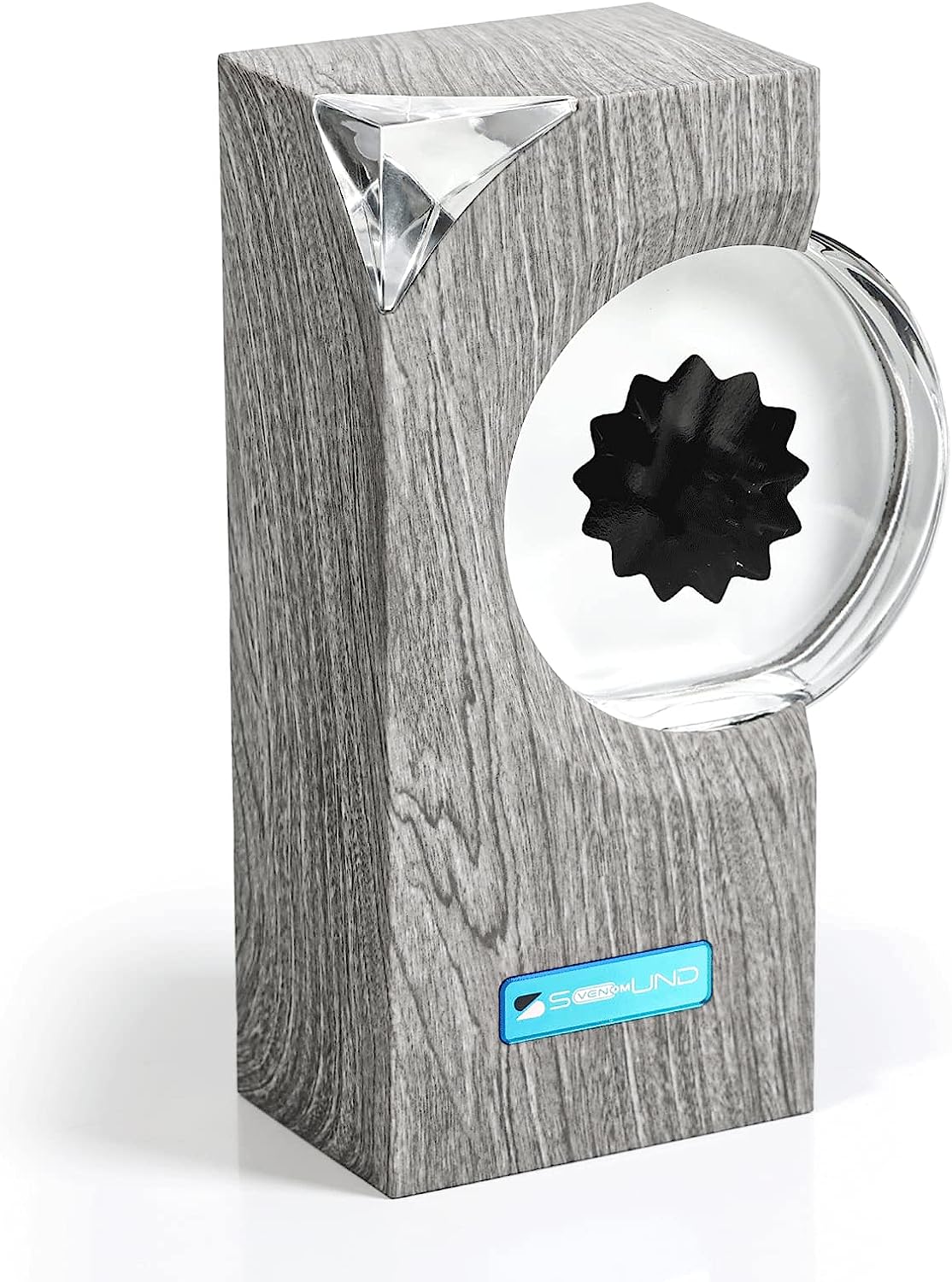
The Sovenomund Dancing Ferrofluid display is a desk ornament that turns nearby sound into motion. Its sealed magnetic liquid forms shifting peaks and shapes while a built-in microphone listens for changes in music and other audio. Despite the casual use of “ferrofluid speaker” in some listings, the F2209A version covered here is a visualizer: it does not play music itself. This Sovenomund ferrofluid display guide explains what the device does, what it cannot do, how to set it up, and which safety and buying checks matter.
Disclosure: As an Amazon Associate, BlockTechBuzz earns from qualifying purchases. The purchase link below is an affiliate link; using it does not change the price you pay.
What the Sovenomund ferrofluid display is
The photographed product is commonly identified as model F2209A. It combines a transparent glass chamber, a small amount of ferrofluid, an electromagnet, a microphone, a white backlight, control electronics, and a rechargeable battery. The microphone detects sound in the room. The electronics use that signal to vary the magnetic field, and the ferrofluid responds by changing shape.
That makes the device closer to a sound-reactive lamp than a Bluetooth speaker. You still need a phone, computer, television, or separate audio system to produce the music. If a listing promises Bluetooth playback, stereo sound, or a built-in speaker, check the exact model number: Sovenomund also sells later products, including the SP-B01 Venom Ball, that do contain speakers. Features from one model should not be assumed to apply to another.

How ferrofluid creates the moving shapes
Ferrofluid is a manufactured liquid containing extremely small magnetic particles suspended in a carrier liquid. A coating around the particles helps prevent them from clumping permanently. Without an external field, a suitable ferrofluid behaves much like a dark liquid. Bring a magnet close and the suspended particles respond, allowing the liquid to be positioned or shaped.
The familiar spikes are associated with normal-field instability. Magnetic forces compete with surface tension and gravity, and the liquid settles into a lower-energy pattern. NASA traces modern ferrofluid development to Stephen Papell’s early-1960s work on controlling liquid rocket fuel in microgravity. The material later found practical uses in loudspeakers, seals, sensors, actuators, and manufacturing. A desk visualizer demonstrates the same broad magnetic response, but it is not a scientific instrument and should not be used to infer precise frequencies or sound levels.
Why the movement does not perfectly match every beat
The display responds to the microphone’s input, the control circuit’s sensitivity, and the electromagnet—not directly to an abstract “rhythm.” Loud transients and bass-heavy passages usually create more obvious changes than quiet or compressed audio. Distance from the sound source, room noise, surface vibration, battery level, and the selected sensitivity also affect the result. Two songs at the same listening volume can therefore look different, and a quiet song may produce little motion.
F2209A features at a glance
| Feature | What to expect | Important limit |
|---|---|---|
| Audio response | Built-in microphone reacts to nearby sound | It does not reproduce audio |
| Display | Sealed glass chamber with ferrofluid and white backlight | Glass is fragile and should stay upright |
| Power | Rechargeable battery and USB-C charging | Runtime varies with battery condition and use |
| Manual interaction | Included magnet can move the fluid through the glass | Magnets require careful handling |
| Placement | Compact indoor desk display | Avoid heat, direct sun, water, edges, and unstable surfaces |
Retail and manual-derived specifications commonly describe dimensions of about 4.17 by 2.13 by 6.73 inches, a weight near 1.62 pounds, and up to roughly eight hours of battery operation. Treat those as model-specific manufacturer claims rather than independent test results. Battery runtime naturally declines with age and can change with backlight use, reaction intensity, temperature, and charging history.
Setup and everyday use
- Inspect the package. Before charging, check the glass for cracks, leakage, severe clouding, or a loose enclosure. Do not power a damaged unit.
- Choose a stable location. Place it upright on a level surface away from a desk edge, direct sunlight, heaters, sinks, and areas where children or pets could knock it over.
- Charge with compatible equipment. Use the supplied USB-C cable and a power source that matches the manual or label. Stop charging if the case becomes unusually hot, swells, smells strange, or behaves erratically.
- Start at a moderate sound level. Put the visualizer near—not on top of—the audio source. Increase volume or move it closer only if the response is too subtle. Protecting your hearing matters more than maximizing the animation.
- Adjust position before assuming a fault. Room noise, distance, a blocked microphone, or a low battery can all reduce movement.
- Power it off after use. Let it cool and store it upright in a dry location.
Small air bubbles may be part of the chamber design and are not automatically evidence of leakage. Keep the device upright and follow the supplied manual rather than opening the vessel. Never add water or another liquid to the chamber.
Safety, magnets, glass, and battery care
The display is a consumer decoration, not a loose-ferrofluid experiment. Its safest state is sealed. Do not disassemble, drill, heat, freeze, or modify it. If the glass cracks or liquid escapes, disconnect power without touching the spill, keep people and animals away, ventilate the area, and follow the seller’s disposal guidance. The exact formulation is not disclosed in the old listing, so a broad “non-toxic” marketing statement is not enough to justify skin contact or cleanup without precautions.
The included magnet is also not a toy. Strong magnets can pinch fingers, damage magnetic-stripe cards, affect compasses and some electronics, and become a serious ingestion hazard. People with implanted medical devices should follow the device manufacturer’s magnet-separation guidance and seek professional advice when uncertain. Store the magnet securely and keep it away from young children.
For the rechargeable battery, avoid prolonged heat, crushing, puncture, and unapproved chargers. Do not leave a damaged battery charging unattended. When the product reaches the end of its life, use an electronics or battery recycling route available in your area rather than putting it in ordinary trash. If you are building a broader desk setup, our Tesla coil safety guide covers a very different—and substantially higher-voltage—music-reactive display.
What to check before buying
- Exact model: Confirm F2209A if you want the slim microphone-reactive display. Do not rely on photos shared across multiple listings.
- Speaker versus visualizer: Decide whether you need audio playback. This version requires another speaker; our Bluetooth speaker buying guide explains the audio specifications that matter.
- Included parts: Verify the USB-C cable, magnet, manual, and stated warranty or return terms.
- Condition: For used units, inspect the glass, seal, charge port, battery behavior, backlight, and microphone response before the return window closes.
- Support: Save the listing, order details, model label, and seller contact information. Marketplace sellers and specifications can change.
- Placement: Measure the intended location and account for charging-cable clearance and the risk of falls.
Do not buy it as a replacement for a lamp that tells time, an audio system, or a calibrated sound analyzer. For a quieter visual desk accessory, compare the practical limitations in our Sharper Image Word Clock review. If the goal is simply to make a work area less stimulating, a device-free interval may help more than another reactive display; see our practical digital-detox guide.
Cleaning and troubleshooting
Turn the unit off and unplug it before cleaning. Use a soft, dry cloth on the exterior. Avoid sprays, abrasive cleaners, solvents, and water near the case or charge port. If the fluid does not react, charge the battery, confirm the unit is on, move it closer to a known working sound source, check that the microphone opening is clear, and try a track with distinct changes in volume. A constant tone or very quiet recording may produce little variation.
If the device shuts down, it may be low on power, in an automatic standby mode, or protecting itself from heat. Let it cool in a safe place, recharge it, and consult the model-specific manual. Repeated overheating, charging failure, leakage, a cracked chamber, battery swelling, or a burnt smell is a stop-use condition—not a reason to open the enclosure.
Using it as a demonstration without overstating the science
The display can start a useful conversation about magnetic fields, colloids, surface tension, and the history of space-program research. A responsible demonstration separates observation from explanation. You can observe that the dark liquid changes shape when the electromagnet is driven and that the pattern changes with sound. You cannot determine the liquid’s exact formulation, particle size, magnetic susceptibility, sound frequency, or field strength merely by watching it.
For a simple comparison, play several recordings at a safe, fixed speaker volume and keep the visualizer in the same position. Note which passages create large or small responses. Then change only the distance. This shows how microphone input affects the result, but it is not a controlled laboratory experiment because the device’s signal processing and sensitivity are undocumented. Do not place loose magnets against phones, watches, storage media, medical devices, or other objects simply to make the demonstration more dramatic.
Ownership costs and longevity
The purchase price is not the only consideration. A sealed glass-and-battery product may be difficult to repair, and the battery may not be designed for user replacement. Ask whether the seller provides replacement cables, warranty service, recycling instructions, or repair options. Keep the original packaging if you expect to move the device; protecting the glass during transport is more important than saving a small amount of storage space.
Visual quality can change over time if the liquid separates, adheres to the chamber, or the battery and electromagnet no longer operate consistently. Avoiding heat and direct sunlight is sensible, but no care routine guarantees indefinite performance. A listing that promises permanent fluid behavior or a maintenance-free lifetime should be treated cautiously unless it supplies a meaningful warranty. Photograph any defect promptly and contact the seller within the return period rather than experimenting with unapproved repairs.
Frequently asked questions
Does the Sovenomund F2209A play music?
No. It uses a microphone to react to sound produced by another device. Later Sovenomund products may include speakers, so always verify the model.
Is the movement an accurate frequency display?
No. The motion is a decorative response shaped by the microphone, electronics, magnetic field, liquid properties, volume, and placement. It is not calibrated test equipment.
Can I open the chamber or replace the liquid?
No. Keep the chamber sealed. Opening it creates spill, glass, contamination, and warranty risks. Contact the seller if the vessel is damaged.
Is it suitable for children?
It contains glass, electronics, a rechargeable battery, and a strong loose magnet. It should be treated as an adult-supervised display, not as a child’s toy.
Conclusion
The Sovenomund F2209A is most convincing as a compact sound-reactive visual display. The ferrofluid offers genuinely interesting magnetic behavior, but the product should not be mistaken for a speaker, laboratory instrument, or maintenance-free toy. Confirm the model, keep the glass upright and protected, handle the magnet carefully, and evaluate the seller’s support and return policy. With those limits understood, it can be an unusual desk ornament without the inflated promises of the original article.
Leave a Reply