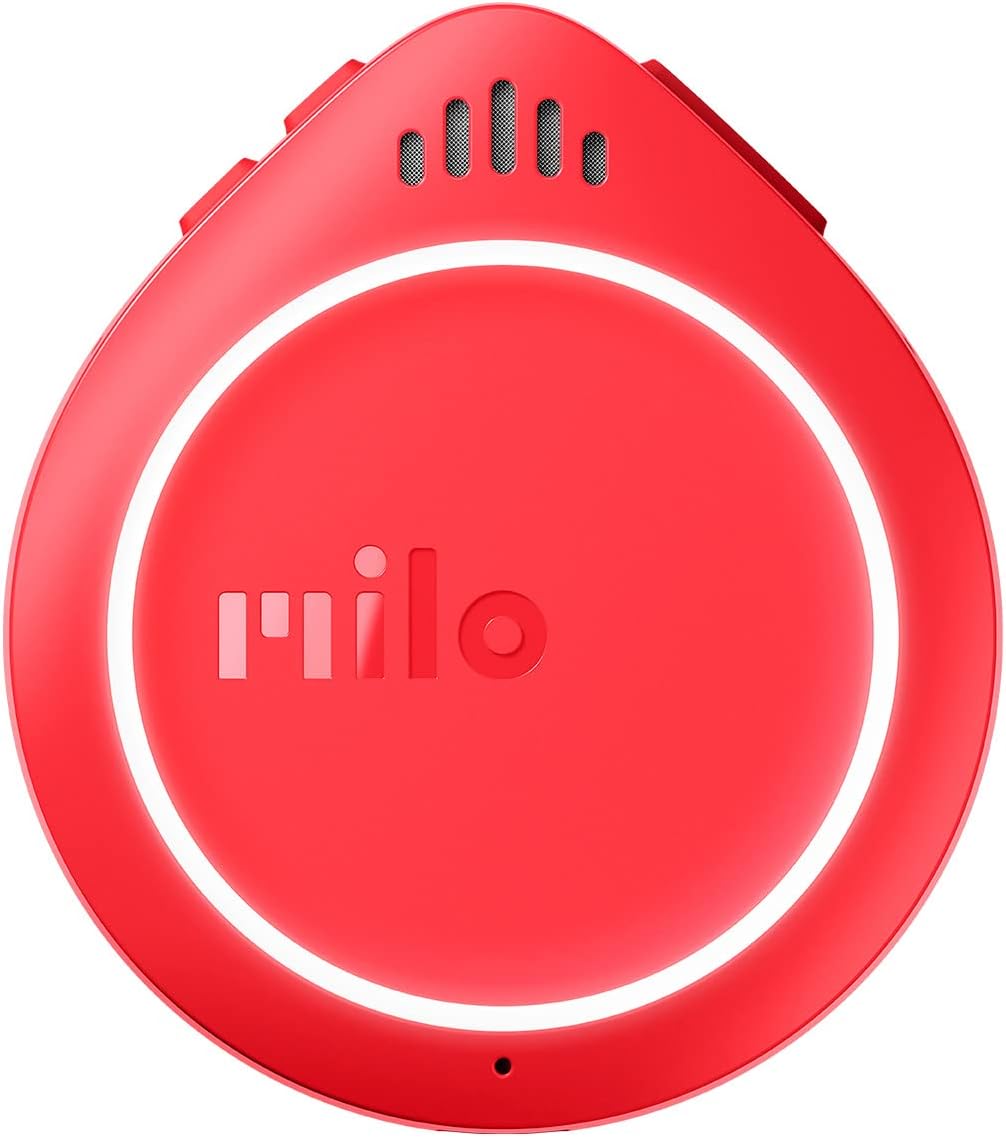
This Milo Action Communicator review examines a wearable group-voice device designed for activities where reaching for a phone or using push-to-talk radios is inconvenient. Milo creates its own short-range radio network, so grouped users can speak without cellular service or Wi-Fi. That makes it interesting for skiing, cycling, hiking, sailing, and other moving groups—but it does not make it an emergency beacon, satellite messenger, or unlimited-range radio.
The most useful way to evaluate Milo is to separate its documented hardware from manufacturer performance claims and real-world limitations. Range depends on terrain and group spacing, battery runtime depends on use, and water resistance depends on an intact device and correctly protected charging port.

What is the Milo Action Communicator?
Milo is a compact wearable communicator built around multi-way, full-duplex group conversation. Unlike a conventional half-duplex walkie-talkie, it lets multiple group members talk without taking turns pressing a transmit button. A manual push-to-talk mode is also available when users prefer tighter control.
Each participant needs a Milo unit. Devices are grouped together and communicate through the proprietary MiloNet radio system. There is no central “primary” unit, and a larger set can be separated into smaller groups. The companion app is available for updates and customization, but Milo says the app is not required for basic setup or operation.
Milo Action Communicator specifications
| Specification | Manufacturer information |
|---|---|
| Weight | Approximately 72 g (2.54 oz) |
| Dimensions | About 7.44 × 6.57 × 2.1 cm |
| Microphones | Six digital microphones with wind and background-noise processing |
| Speaker | Rated at 93 dB at 0.1 m |
| Network | Proprietary MiloNet mesh using sub-GHz and 2.4 GHz bands |
| Battery | Integrated lithium-polymer battery, USB-C charging |
| Weather protection | IP67; up to 1 m of water for 30 minutes under the rating |
| Headsets | Optional Bluetooth or wired headset support |
These are product specifications and controlled-test claims, not independent test results. The manufacturer also states that the enclosure has been drop-tested from 2 m and tested for short periods at greater water depth. Buyers should rely on the IP67 rating—not an informal “waterproof” label—when deciding how to use it.
How MiloNet group communication works
Grouped Milos form an ad hoc mesh rather than connecting through a mobile tower or home router. The manufacturer lists up to roughly 600 m (2,000 ft) between two units, depending on terrain and conditions. A group spread across several units may extend the effective path because units can relay communication.
That figure should not be treated as a guaranteed radius. Hills, trees, buildings, the wearer’s body, radio interference, mounting position, weather, and the spacing of group members can reduce performance. A mesh can help when intermediate users remain connected, but it cannot bridge every obstruction or arbitrary distance.
- Full-duplex conversation: group members can speak naturally instead of waiting for an open channel.
- Local operation: no mobile subscription, Wi-Fi network, or paired phone is required for basic group voice.
- Group privacy: Milo says grouped voice traffic is digitally encoded and encrypted.
- Mute and push-to-talk: users can silence their microphone or hold the main button for manual transmission.
Encryption reduces casual interception but should not be described as eliminating every privacy risk. Users still need physical control of grouped devices, current firmware, appropriate group setup, and sensible treatment of sensitive conversations.
Hands-free audio and noise reduction
Milo uses six microphones and proprietary signal processing for wind noise, background noise, and echo. The open conversation model is its main distinction: a skier or cyclist can answer without first finding a radio button. Users can still reach the large front control to mute or switch to push-to-talk.
Noise processing cannot make every environment clear. Strong wind, helmets, clothing, moving water, machinery, distance from the mouth, and mounting location all affect intelligibility. Mount the device on the upper body near the mouth and ears as Milo recommends, then test it in the actual activity before depending on it.
An optional wired or Bluetooth headset can improve privacy or audibility, but it adds another battery, cable, pairing process, or weather-exposed component. Check headset controls and latency before setting out.
Battery life and charging
Milo describes the integrated battery as providing a full day under normal conditions and lists about 90 minutes for a full charge from empty. “Full day” is not a standardized runtime. Volume, conversation activity, temperature, radio conditions, firmware, battery age, and connected accessories can change the result.
The unit charges by USB-C and can be connected to a power bank while a conversation continues. Charging outdoors compromises mobility and may expose the port or cable to moisture. Inspect and dry the connector before charging, follow the manufacturer’s safety instructions, and stop using a damaged, punctured, unusually hot, or abnormal-smelling unit.
For broader guidance on lithium-ion care, see our smartphone battery-life guide. The same fundamentals—avoiding heat, physical damage, and unsuitable charging equipment—matter even though the devices are different.
Water resistance and ruggedness
The IP67 rating indicates dust protection and temporary immersion in fresh water up to 1 m for 30 minutes under specified test conditions. It does not guarantee protection against every impact, high-pressure spray, hot water, chemical, salt exposure, or damaged seal. Milo advises rinsing the device with fresh water after salt-water use.
- Fit the supplied port protection as directed before wet use.
- Inspect the enclosure and clip after a crash or hard impact.
- Do not charge a wet or contaminated USB-C port.
- Stop using a cracked, punctured, swollen, or overheating device.
- Do not disassemble or attempt an unauthorized battery repair.
People recording the same outdoor activities may also want our DJI Osmo Action 3 buying guide, which explains similar distinctions between rated conditions and real-world use.
Safety limitations: what Milo does not replace
Milo is a convenience and coordination device. It does not provide cellular calling, satellite SOS, search-and-rescue monitoring, GPS location sharing, marine distress functions, or guaranteed communication. A group can lose contact because of terrain, distance, a depleted battery, damage, incorrect grouping, or radio conditions.
- Carry the emergency equipment appropriate to the activity and location.
- Share a route and return time with a responsible person.
- Agree on regrouping points and actions for lost communication.
- Keep visual supervision where required, especially around children, traffic, water, or technical terrain.
- Follow local radio, marine, aviation, resort, trail, and road rules.
Communication equipment should reduce distraction, not encourage riskier behavior. Cyclists and drivers must keep attention on the route; skiers and riders still need safe spacing and situational awareness. For activities involving aircraft or restricted spaces, consult the regulatory issues in our drone technology and safety guide.
Setup and pre-trip checklist
- Update every unit through the official app and confirm the same expected features.
- Group the intended devices and label them if several sets are present.
- Charge fully and inspect the body, controls, clip, and port protection.
- Test normal conversation, mute, push-to-talk, range, and optional headsets.
- Choose a secure mounting position near the mouth and ears.
- Practice what to do if a member drops out of range.
- Pack an appropriate backup and emergency plan.
Who should consider Milo?
Ownership, updates, and long-term use
Because Milo relies on proprietary hardware, firmware, and grouping behavior, long-term usefulness depends partly on manufacturer support. Install updates through the official app, read release notes, and retest group behavior after meaningful firmware changes. Do not assume a newly advertised software feature is present on every unit until the installed version is confirmed.
The integrated battery supports sealing but is not as convenient to replace as a removable radio battery. Capacity will decline with age and use. Before a major trip, charge and test each unit long enough to expose a weak battery rather than checking only that it powers on. Store devices dry, avoid prolonged heat, and periodically inspect units that sit unused.
Accessories matter to the total cost. The standard package listed by Milo includes an Action Clip, USB charging cable, lanyards, and port caps, while other mounting styles and headsets may be separate. Confirm regional package contents, warranty terms, return policy, and compatible accessories with the seller at purchase time.
Milo compared with other communication options
| Option | Strength | Important limitation |
|---|---|---|
| Milo | Natural multi-way voice without phone coverage | Every user needs proprietary hardware; range is terrain-dependent |
| Conventional two-way radio | Established channels, accessories, and replaceable-battery options | Usually push-to-talk and may require licensing or channel coordination |
| Phone or voice-chat app | Uses hardware people already carry | Depends on network coverage, data service, and device handling |
| Satellite messenger | Remote messaging and, on supported devices, monitored SOS | Subscription, sky-view, latency, and service limitations |
The right choice follows the risk assessment. Milo is optimized for fluid conversation inside a nearby group. It is not automatically the best tool for public-event coordination, professional radio fleets, long expeditions, marine distress, or locations where rescue communication is the primary requirement.
Milo makes the most sense for a recurring group that values natural conversation while moving and normally remains within short-range radio reach. Ski instructors, cycling partners, families on trails, and small water-sports groups may appreciate the hands-free model. The cost should be evaluated per participant, because useful group communication requires multiple units and possibly activity-specific clips or headsets.
A conventional radio may be better when standardized channels, removable batteries, broader accessory ecosystems, or interoperability with an existing radio fleet matter. A phone may be sufficient where coverage is dependable. A satellite communicator or recognized distress device is more appropriate when remote emergency signaling is the main requirement.
Amazon Associate disclosure: As an Amazon Associate, BlockTechBuzz may earn from qualifying purchases made through the link below, at no additional cost to you.
Frequently asked questions
Does Milo need a phone or Wi-Fi?
No for basic grouped voice communication. Milo’s app is used for software updates and customization, but the manufacturer says it is not required for setup or operation.
How far does Milo work?
The manufacturer lists up to about 600 m between two units depending on terrain and conditions. Obstacles and radio conditions can reduce that distance, while intermediate group units may extend a connected mesh.
Can Milo be used in water?
It carries an IP67 rating for temporary immersion up to 1 m for 30 minutes under test conditions. Inspect the device, protect the charging port, rinse after salt exposure, and follow the official care instructions.
Is Milo an emergency communicator?
No. It cannot contact emergency services or a satellite rescue network by itself and should not replace the safety equipment required for a remote or hazardous activity.
Conclusion
Milo’s full-duplex, hands-free group conversation is genuinely different from a conventional push-to-talk radio. Its value depends on the activity, group size, terrain, and willingness to buy and maintain a unit for each participant. Treat range, runtime, ruggedness, and noise reduction as conditional manufacturer claims, test the complete group before use, and keep an independent emergency plan.
For the right nearby group, that focused design can be convenient and enjoyable.
Leave a Reply